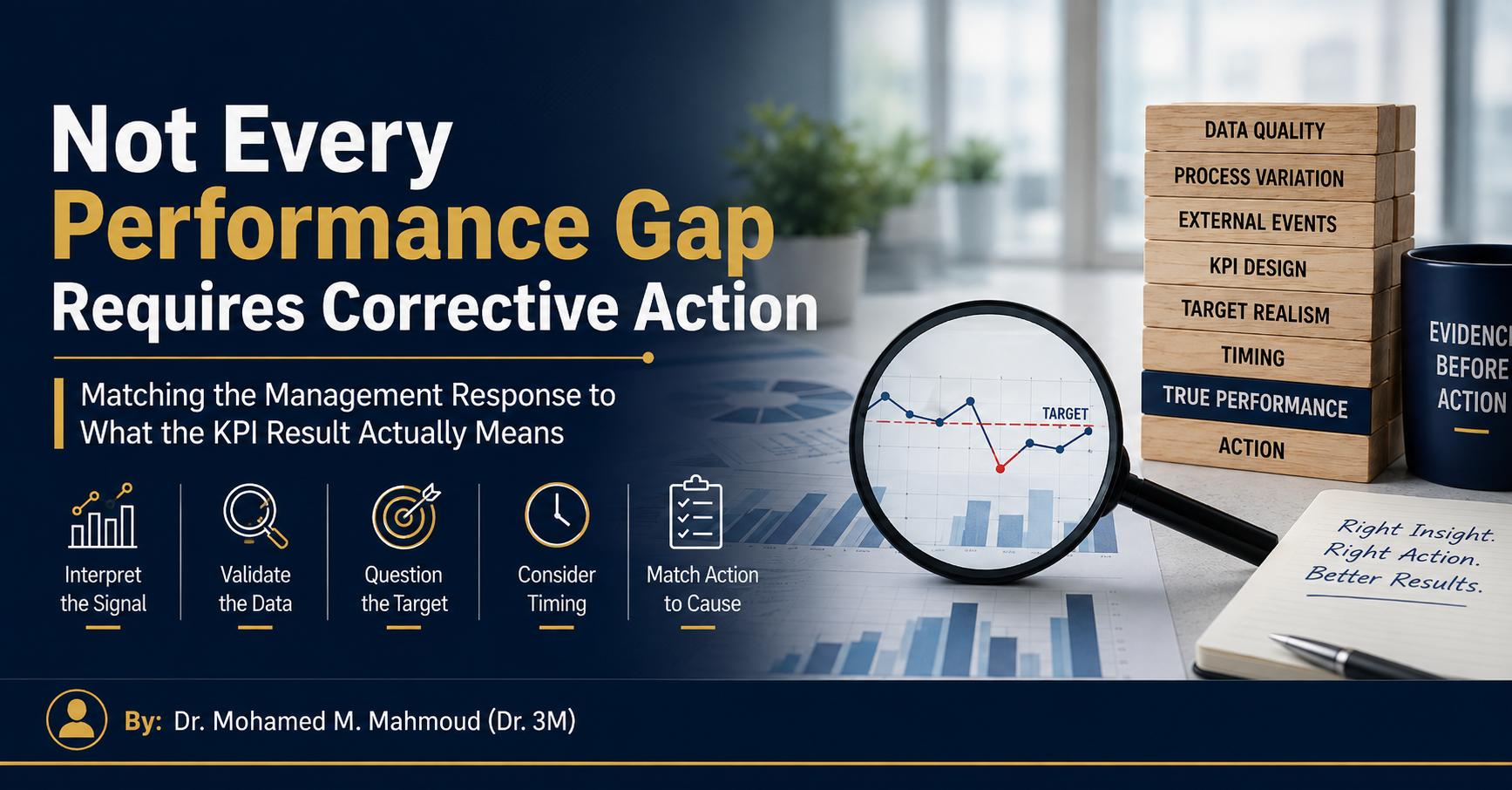

Not Every Performance Gap Requires Corrective Action
Matching the Management Response to What the KPI Result Actually Means
By: Dr. Mohamed M Mahmoud (Dr. 3M)
Executive Summary
An adverse KPI result does not automatically prove that a correctable performance failure has occurred. A performance gap is a management signal that requires interpretation before intervention.
This article distinguishes seven conditions that may lie behind a missed KPI target: a genuine execution failure, normal process variation, a temporary external event, unreliable data, an inappropriate KPI definition, an unrealistic or outdated target, and a delayed performance effect. Only the first condition normally requires immediate corrective action. The others may justify continued monitoring, further investigation, data correction, KPI redesign, target reconsideration, preventive action, contingency planning, or modification of an existing intervention.
The article proposes a disciplined decision process that begins by validating the reported result, assessing whether the deviation represents a meaningful signal, examining its causes, reviewing the validity of the KPI and target, and considering the expected time required for an intervention to produce results.
The central message is clear: the quality of performance management should not be judged by how quickly an organization produces an action plan, but by how accurately it interprets the evidence and matches its response to the true nature of the performance gap.
When a key performance indicator falls below its target, the most common managerial response is immediate and familiar: What corrective action will be taken?
This question may be appropriate, but asking it too early can lead to the wrong decision. A reported performance gap does not automatically prove that an operational failure has occurred. It may reflect normal process variation, unreliable data, an inappropriate KPI definition, an unrealistic target, an unusual external event, or the delayed effect of an intervention already underway.
A performance gap is the difference between expected or targeted performance and the result actually reported. It is an important management signal, but it is not a diagnosis. It shows that actual performance differs from expectation; it does not explain why the difference occurred or determine what management should do about it.
This distinction is especially important when using the term corrective action. In quality-management terminology, corrective action is intended to eliminate the cause of an actual nonconformity and prevent its recurrence. It is therefore appropriate only when there is a genuine performance problem with an identifiable cause that the organization can reasonably address.
The governing principle should be: A performance gap should trigger interpretation before it triggers intervention.
Management should first determine what the gap represents and then selects a response proportionate to the evidence.
1. A Genuine Performance Problem
A reported gap may reflect a genuine execution failure. Examples include:
Noncompliance with an established procedure.
A bottleneck within a critical process.
Insufficient employee knowledge or capability.
Inadequate availability of financial, human, or technological resources.
Delayed decisions or approvals.
Weak coordination between departments.
Failure to complete an agreed action.
A breakdown in an established control.
Incorrect implementation of a previously approved plan.
In these situations, the result is not merely a statistical fluctuation or measurement problem. Something within the operating system has failed to perform as required.
Where the cause is known, supported by credible evidence, and within the organization’s control, corrective action is normally appropriate. The intervention should be designed to eliminate or control the validated cause and reduce the probability that the problem will recur.
For example, if delivery performance has declined because orders remain in an approval queue for several days, the response should address the approval bottleneck. Depending on the evidence, this might involve clarifying decision rights, redesigning the workflow, revising authority limits, automating approvals, or increasing capacity at a critical stage.
The appropriate response is not determined by the name of the KPI. It is determined by the cause of the gap.
Corrective action should therefore specify:
The validated cause to be addressed.
The intervention selected to address it.
One clearly accountable owner.
Supporting contributors.
Required authority and resources.
Implementation milestones and dates.
The expected effect on performance.
The measures that will be used to verify effectiveness.
Escalation arrangements if progress is delayed.
Corrective action is justified when a correctable failure has been established. It should not be treated as the default response to every adverse number.
2. Normal Process Variation
Every process exhibits some degree of variation. Delivery times, production volumes, processing durations, customer demand, error rates, and service outcomes will rarely remain identical from one period to another.
A minor deviation from a KPI target may therefore fall within the normal behavior of a stable process rather than indicate that a new problem has emerged.
Statistical process control distinguishes between two broad forms of variation:
Common-cause variation, which is inherent in the current design and operation of the process.
Special-cause variation, which arises from an unusual event, condition, or change that is not part of the process’s normal behavior.
Control limits are calculated from process data and help indicate the range of variation expected from common causes. A result outside a control limit may provide evidence that a special cause is affecting the process.
Reacting to every small fluctuation as if it represented a special problem can produce unnecessary interventions. Managers may change procedures, reassign employees, add controls, or issue new instructions in response to movements that are part of the process’s normal behavior. Such adjustments can increase confusion and make performance less stable.
Before demanding corrective action, practitioners should examine:
Historical performance patterns.
The size and direction of the deviation.
Whether the result is isolated or persistent.
The process average and degree of variation.
Established tolerance levels.
Statistical control limits, where appropriate.
Relevant seasonal or cyclical patterns.
Changes in workload, case mix, or operating conditions.
It is also important to distinguish control limits from performance targets or specification limits. Control limits describe how the process currently behaves. Targets and specifications describe what the organization requires.
A process can be statistically stable but still perform consistently below the required level. In that situation, the organization may not need corrective action in response to one particular data point. It may instead require a broader improvement initiative to change the process itself, shift its average performance, or reduce its inherent variation.
Normal variation may therefore justify continued monitoring, while stable but inadequate performance may justify process improvement or redesign.
3. A Temporary External Event
A performance gap may arise from an unusual external event that the organization did not cause and could not fully control. Examples include:
Extreme weather.
A temporary regulatory restriction.
A major supplier disruption.
A short-term transportation interruption.
A sudden change in market demand.
A public-health emergency.
A regional technology or communications failure.
An unexpected interruption in essential utilities.
The existence of an external cause does not mean that management should ignore the gap. It changes the questions that management needs to ask.
The investigation should assess:
What external event occurred?
How strong is the evidence linking it to the gap?
What was the magnitude and duration of its effect?
Is the event likely to recur?
Could the organization reasonably have anticipated it?
Was the organization’s exposure to the event acceptable?
Did existing contingency arrangements operate effectively?
Could the consequences have been reduced through greater resilience?
If the event was genuinely exceptional and unlikely to recur, continued monitoring may be sufficient once operations return to normal.
However, an external cause does not automatically remove management responsibility. If similar disruptions are reasonably foreseeable, the appropriate long-term response may include preventive action, supplier diversification, additional capacity, alternative operating arrangements, stronger business-continuity plans, or other resilience measures.
The immediate performance gap may not require corrective action against the core operating process. Nevertheless, it may reveal a weakness in the organization’s ability to anticipate, absorb, and recover from disruption.
The distinction is therefore between:
Correcting an internal performance failure.
Preventing or mitigating exposure to a future external event.
Monitoring an exceptional event that is unlikely to recur.
These are different management responses and should not be treated as interchangeable.
4. Incorrect, Incomplete, or Unreliable Data
A reported performance gap may be created or distorted by faulty data. Possible problems include:
Incorrect data entry.
Missing records.
Duplicate transactions.
Inconsistent classification.
Inappropriate cut-off dates.
Delayed system updates.
Incorrect extraction from source systems.
Failure to apply the approved formula.
Changes in data sources or collection procedures.
Weak verification and approval controls.
Where the reported result is unreliable, the first response should address the measurement problem.
Management may need to:
Validate the underlying data.
Reconcile the result with source records.
Correct inaccurate or duplicate records.
Complete missing information.
Clarify data definitions and responsibilities.
Strengthen collection and verification controls.
Recalculate the KPI.
Restate previously reported results where necessary.
Document the nature and effect of the correction.
The United States Government Accountability Office distinguishes between verification, which considers completeness, accuracy, and consistency, and validation, which considers whether the data are appropriate for the performance measure. Reliable performance comparison is possible only when the underlying data are sufficiently complete and credible.
It would be inappropriate to redesign operations, discipline employees, or allocate substantial resources in response to a gap that exists only because the data are wrong.
However, correcting the reported number should not automatically close the matter. A data-quality failure may itself represent an important control weakness. The operational gap may disappear after recalculation, while a separate measurement-system problem remains and requires action.
Management should therefore distinguish between:
A genuine performance gap.
A reporting error that created a false gap.
A combination of an actual performance problem and a measurement problem.
The response should address each problem separately.
5. An Inappropriate KPI Definition
The data may be accurate while the KPI itself is poorly designed.
A KPI may fail to represent the intended dimension of performance because of weaknesses in its:
Definition.
Formula.
Unit of measurement.
Scope.
Reporting frequency.
Inclusion or exclusion rules.
Data source.
Level of aggregation.
Treatment of exceptional cases.
Relationship to the strategic objective.
Susceptibility to manipulation or unintended behavior.
For example, measuring the number of customer requests closed may reward rapid closure without considering whether the issue was actually resolved. Measuring average processing time may conceal serious delays affecting a small but important group of cases. Measuring total sales without considering profitability or returns may produce an incomplete picture of commercial performance.
A KPI should not merely produce a number. It should provide valid, understandable, and actionable information about the performance dimension it is intended to represent. NIST’s Baldrige guidance emphasizes that organizations should select measures that reflect what they value and generate information that can support action.
Where the KPI definition is inappropriate, the organization should review its design rather than immediately changing the underlying operation.
This review may result in:
Clarifying the KPI definition.
Correcting the formula.
Revising the scope.
Adding necessary exclusions or segmentation.
Changing the reporting frequency.
Replacing an unsuitable data source.
Introducing complementary or balancing indicators.
Replacing the KPI with a more valid measure.
Revising a KPI does not mean altering it merely to produce a favorable result. The purpose is to ensure that it measures the intended performance accurately, consistently, and usefully.
Any change should be formally governed and documented. If the revised definition materially changes the KPI’s meaning, management should consider whether historical results need to be recalculated. If recalculation is not possible, the break in comparability should be disclosed rather than presenting the old and new results as one continuous trend.
6. An Unrealistic or Outdated Target
The KPI may be valid and the reported result may be accurate, while the target itself is inappropriate.
A target may become questionable when:
It was established without a reliable baseline.
It was based on incorrect assumptions.
It ignored resource or capacity constraints.
It was copied from an organization operating under different conditions.
It was established through negotiation rather than analysis.
A significant change occurred in strategy, regulation, technology, demand, or operating scope.
The definition of the KPI changed after the target was approved.
The required time for achieving the target was underestimated.
The target no longer reflects the organization’s strategic priorities.
Missing a poorly established target does not automatically prove that execution failed.
Where credible evidence demonstrates that a target was invalid when established or has become unsuitable following a material change, management may legitimately reconsider it.
Any revision should be:
Supported by credible evidence.
Based on a valid baseline and explicit assumptions.
Formally reviewed and approved.
Documented transparently.
Consistent with strategic and stakeholder requirements.
Reflected in forecasts, plans, and accountability arrangements.
Free from attempts to conceal weak performance.
A revised target should not erase or rewrite history. Reports should retain the original target, explain why it was revised, identify the approving authority, and show when the new target became effective.
Target reconsideration is a legitimate management decision when it improves the validity of the performance system. It becomes dysfunctional when targets are lowered simply because they were missed.
The key distinction is between:
Revising a target because the evidence demonstrates that it is no longer valid.
Manipulating a target to make poor performance appear acceptable.
The first strengthens performance management. The second undermines accountability.
7. A Delayed Performance Effect
Some interventions require time before their effects appear in an outcome KPI.
Examples include:
Training may take time to influence employee productivity.
Marketing campaigns may take time to generate qualified leads and revenue.
Preventive maintenance may take time to reduce equipment failures.
Leadership-development initiatives may take time to affect employee engagement.
Process redesign may require a stabilization period.
Digital transformation may initially disrupt productivity before producing benefits.
Recruitment may take time to influence service capacity and quality.
An outcome KPI may therefore remain below target even while the intervention is being implemented correctly and early evidence is favorable.
This does not mean that management should wait indefinitely or assume that improvement will eventually occur. It means that the expected causal sequence and time lag should be explicitly defined.
Management should distinguish among three levels of measurement:
Implementation indicators
These show whether the intervention is being delivered as planned.
Examples include completion of system installation, percentage of employees trained, recruitment progress, completion of redesigned procedures, or adoption of a new workflow.
Leading or intermediate indicators
These provide early evidence that the intervention is beginning to influence the drivers of future performance.
Examples include increased use of a new system, improved employee competency scores, growth in qualified marketing leads, greater compliance with preventive-maintenance schedules, or reduced process waiting time.
Outcome indicators
These measure the final performance result the intervention is intended to improve, such as revenue, productivity, engagement, equipment availability, customer satisfaction, or profitability.
NIST’s performance-measurement guidance recommends using both leading and lagging indicators and examining in-process performance, process outputs, and outcomes.
Similarly, the Institute for Healthcare Improvement recommends using a set of outcome, process, and balancing measures to understand whether a change is being implemented and whether it is producing improvement without creating problems elsewhere.
Where implementation and leading indicators are progressing as expected, continued monitoring may be more appropriate than launching a new corrective action against the outcome KPI.
Where implementation is delayed or leading indicators are not improving, management may need to modify or replace the existing intervention.
The passage of time should therefore be based on an explicit results hypothesis, not on passive hope.
Matching the Response to the Meaning of the Gap
The following table summarizes the different conditions that may lie behind a reported KPI gap and the management response most likely to be appropriate.
What the gap represents
Appropriate primary response
A known and controllable execution failure
Corrective action
A significant gap with uncertain causes
Further investigation
A minor fluctuation within normal process behavior
Continued monitoring
A stable process that consistently performs below requirements
Process improvement or redesign
A temporary external event unlikely to recur
Monitoring and recovery
A foreseeable or recurring external risk
Preventive action and contingency planning
Incorrect, incomplete, or unreliable data
Data validation, correction, and KPI recalculation
An inappropriate KPI definition
KPI review and redesign
An unrealistic or outdated target
Formal target reconsideration
A delayed outcome effect with positive early evidence
Continued monitoring of implementation and leading indicators
A delayed outcome effect with weak implementation or unfavorable early evidence
Modification or replacement of the intervention
This classification does not remove the need for managerial judgment. It improves that judgment by ensuring that the response corresponds to what the evidence indicates the gap actually represents.
A Disciplined Decision Process
Before approving corrective action, management should work through six questions.
1. Is the reported result reliable?
Validate the data, calculation, scope, timing, and source before interpreting the gap.
2. Does the result represent a meaningful signal?
Examine its magnitude, persistence, historical pattern, tolerance level, and statistical behavior.
3. Is there a genuine performance problem?
Determine whether execution, capability, capacity, coordination, controls, or decisions have failed.
4. Is the KPI measuring the intended performance?
Review the indicator’s definition, formula, scope, exclusions, frequency, and strategic relevance.
5. Is the target still valid?
Examine the baseline, assumptions, strategic requirements, operating conditions, and changes in the external environment.
6. What response best fits the evidence?
Select continued monitoring, further investigation, corrective action, preventive action, process improvement, intervention modification, resource reallocation, escalation, target reconsideration, or KPI redesign as appropriate.
This sequence prevents the organization from treating all adverse KPI results as though they were the same kind of problem.
Deliberate Monitoring Is Not Inaction
Managers sometimes fear that choosing to monitor a gap rather than immediately launching an intervention will appear passive. This concern can produce unnecessary action plans and create the impression that every unfavorable result must be matched with a new initiative.
Continued monitoring, when supported by evidence and explicit review conditions, is a legitimate management decision.
A monitoring decision should specify:
Why immediate corrective action is not currently justified.
What evidence will continue to be collected.
Which indicators will be monitored.
Who is responsible for monitoring them.
When the result will be reviewed again.
What threshold or pattern will trigger investigation or intervention.
How the issue will be escalated if conditions deteriorate.
Monitoring becomes passive only when no one owns it, no review date is established, or no criteria are defined for future action.
Conclusion
An adverse KPI result deserves management attention, but attention should not be confused with immediate corrective action.
A performance gap may represent a genuine execution failure, normal variation, a temporary external event, unreliable data, a poorly designed KPI, an invalid target, or the delayed effect of an existing intervention. Each condition requires a different response.
The quality of performance management should therefore not be judged by how quickly an organization produces an action plan. It should be judged by how accurately the organization interprets the evidence and how effectively it matches its response to the nature of the gap.
The first question should not always be: What corrective action will we take?
It should be: What does this gap actually represent, and what response does the evidence justify?
When organizations ask this question consistently, they avoid unnecessary interventions, protect the credibility of their measurement systems, allocate resources more intelligently, and make performance management a disciplined process of evidence-based decision-making.